
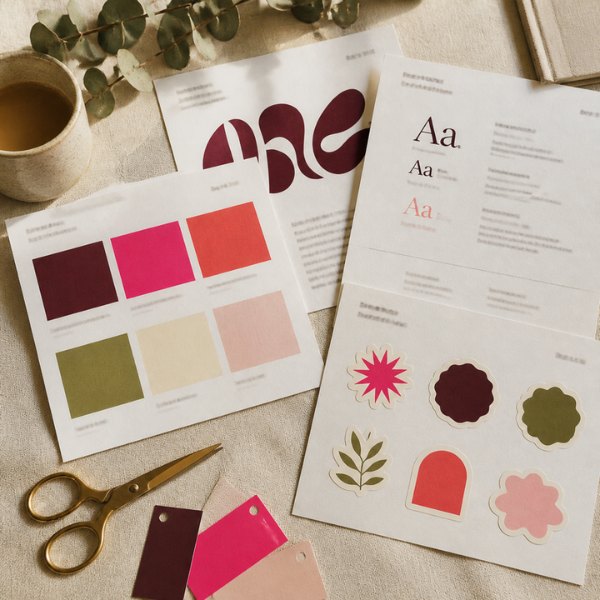
A small business brand guide should include who you serve, what you promise, your voice (with the words you use and avoid), your logo and its rules, your colors with exact codes and where each one goes, your fonts, your photo style, and your offers and stories. Write each part in plain words, not just pictures, so a designer, a new team member or your AI can follow it without asking you.
What is a brand guide, really?
Most small business owners I meet either don't have one, or have a logo file and a color palette someone sent them years ago. That's a start, but it isn't a guide. A guide answers the questions people would otherwise text you about.
The 8 things to include
1. Who you serve
One specific person, not "everyone." What she's dealing with, what she wants, and how you want her to feel when she finds you.
2. What you promise
Your one-sentence promise, and why you're the one to make it. Mine: your AI is only as strong as your brand. Brand is the foundation of the house; AI is the wiring.
3. Your voice
Three words with a "but not" (mine are warm, but not gushing; confident, but not pushy; simple, but not basic), the words you use, the words you never use, and a few real samples of your writing.
4. Your logo and the rules
Which version goes where (main, horizontal, the small icon), the smallest size it can be, and the don'ts: no stretching, no recoloring, no retyping it in another font.
5. Your colors, with codes and jobs
Each color's hex code (the six-character code websites use, like #6B1D33) and what that color is for. In my guide, burgundy is for text and dark sections, and the bright pinks and corals are for headlines and shapes only, never paragraphs. I even wrote down the rough mix: about 55% cream and blush, 25% burgundy, 10% hot pink, 10% coral and olive. That one rule stops most "why does this look off?" moments.
6. Your fonts
Your headline font, your body font, and how to use them. One of my rules: headlines are typed in lowercase with one capital letter, and that letter becomes a script swash. Nobody would ever guess that. That's exactly why it's written down.
7. Your photo style
Light, setting, mood and what to avoid. Mine: natural light, real workspaces, warm and muted, never cool or neon.
8. Your offers and your stories
What you sell, at what price, and the true stories you're happy to share (plus the ones that stay private). This is the part most brand guide templates leave out, and it's the part your AI needs most.
Why "write it in words" matters now
A designer can look at a mood board and get it. AI can't read a vibe. If your guide is mostly pictures, it works for people, but your AI only gets what's written. "Calm, confident, no hype, never says leverage" is something Claude can follow. A pretty page of swatches is not.
I've seen what happens without the foundation. An insurance agent came to me after going with a cheaper website company first. The site technically worked, but it didn't sound like him, and there was almost nothing about him on it. When we rebuilt, we started with his foundation and his stories, then built everything on top. The before and after was huge, and now he can update his own site himself.
Do I need a designer to make one?
Not to start. The written parts (who you serve, your promise, your voice, your offers, your stories) are things only you can answer, and you can write them this week in a Google Doc. A designer helps with the visual side: logo versions, a color system that works on screens and in print, fonts that fit. If you already have a logo and colors, write down the rules you already follow and you're halfway there.
How long should it be?
Long enough to answer the questions, short enough that people actually read it. Mine is long because I run a brand studio. Yours doesn't need to be. A few clear pages you keep up to date beat a beautiful 60-page PDF nobody opens.
Brand strategist, web designer and former software engineer. I run Sonder Brand House, a brand, website and AI studio in Houston, Texas, and I teach business owners to use AI in their own voice.